

In May of 2020, my world had grown small, consisting of roughly 2,000 square feet behind red brick on the north side of Lafayette. We were in the height of the Covid 19 pandemic, schools had been shut down since March, and the offices at my corporate job were closed and we were working from home.
My kid, having just finished an abbreviated freshman year, and I needed a change of scenery and fresh air. Weather forecast for fishing along the coast were looking marginal at best, there was a certainty of having to push pole in enough wind to make fishing difficult, so the idea of attempting a saltwater trip didn’t hold much appeal. There is much fresh water nearby to where we live, but river levels were running high and dirty water was a likelihood, so I wasn’t very optimistic about our chances of success freshwater fishing either. We decided instead to hook up the boat and visit old friends.
A short drive from home, and roughly just 10 miles after crossing into St. Martin Parish from Lafayette Parish, you reach the edges of the Atchafalaya Basin. The Atchafalaya Basin is the largest river swamp in the U.S. running 140 miles from Simmesport, Louisiana to the Gulf of Mexico, and encompassing nearly a million acres. Much of my youth was spent in the Atchafalaya Basin, it’s where I learned to fish under the impatient guidance of my father.
On that day in May my kid and I were traveling quite a bit farther south, passing through St. Martin Parish, into Iberia Parish, and once on the water, crossing at times into St. Mary Parish. The old friends we were going to visit are some of the last stands of true old growth cypress trees left in the basin.

Beginning in the 1700’s logging operations began removing most of the old growth cypress trees from the basin with logging peaking in the early 20th century. Logging of second growth cypress trees became a threat in the year 2,000 as trees were being logged for use in cypress mulch sold by your nearby big box store. Fortunately through the efforts and tireless work of a few grass roots organizations like the Atchafalaya Basin Keepers, all logging of cypress trees is currently halted in the Atchafalaya basin. There are a few areas of the Atchafalaya Basin where pockets of old growth cypress trees remain. We launched the boat and ran about 10 miles south to reach the stand of trees.
This was actually the first opportunity I’ve had to get the kid out in my new skiff, so once we were in the relatively open water of a broad channel, I turned over the helm. Driving the skiff was an adjustment as every other boat the kid’s driven was tiller steer, but it didn’t take long before the boat was being handled with near mastery. Before long we drew near the area where the old growth trees are found, we made a gentle turn toward them and backed off of the throttle.
Almost immediately after coming off of plane we spotted a juvenile bald eagle soaring above the old cypress trees, then lighting in the top of one. Bald Eagles have once again become a common sight in the basin, which now host the second largest population of Southern Bald Eagles in the US, surpassed only by the Everglades.
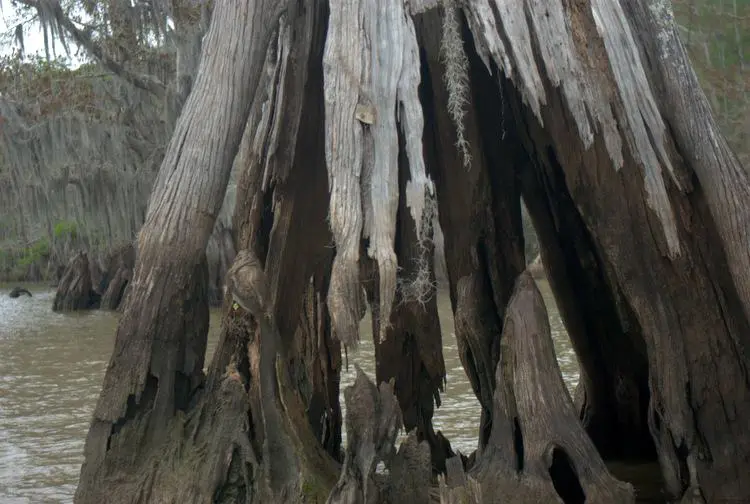
I took over the helm and we idled into the flooded grove of trees. Spanish moss hangs from branches that are supported on trunks that are gnarled and as often as not, hollowed out. Many of the old cypress trees fan out at their base, broadening as they meet the water, and having the appearance of having folds in the trunk.

Travel deep enough into the trees, and things grow darker as less of the sky is visible. I often feel that the Atchafalaya Basin is where the Earth keeps her deep and dark secrets. It is filled with shadowy places that have a feel of mystery, and hold place in the legends of the native Chitimacha Tribe that once thrived as a great nation here.
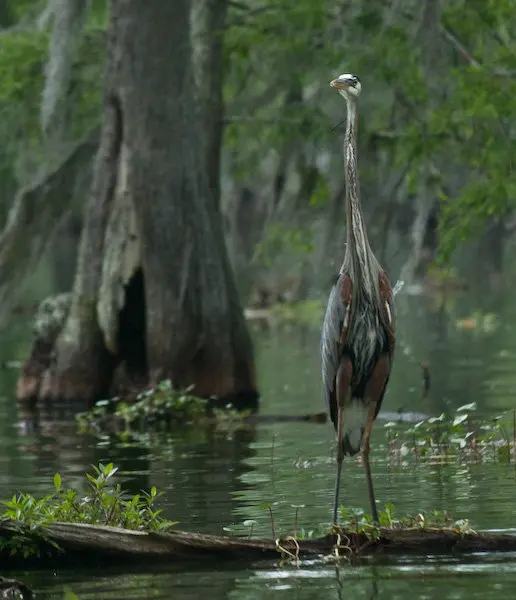
As we idled, weaving between the trees, wildlife abound. We saw several alligators as well as snakes, and numerous varieties of birds. In addition to the eagle, there were osprey, great blue heron, greater egrets, swallows, various ducks, prothonotary warblers, and we even had a glimpse of a pileated woodpecker. A great blue heron stood tall, it’s front coloration matching perfectly the color gradient of an old cypress with a hollowed out trunk

There are many spectacular old trees here, many enormous across the base, most not very tall. Because of the relative southern location of these trees, they have over the centuries had to weather storms and hurricanes and as such are short relative to their age and girth, looking much like twisted bonsais, trained and shaped by the hand of the creator. Some of the trees in this area have been aged at roughly 1,500 years old. They have seen the decline of one civilization, the Chitimacha tribe, and the rise of ours. Perhaps they’ll see the fall of ours as well.
As many magnificent old trees as there are in this area, there is one in particular that stands out, and that I always make a point of visiting when I’m in the area. We call her the Grandmother Tree, as she seems to be the matriarch of the area. We found the Grandmother Tree and pulled close, both climbing out of the boat and onto the over the water platform created by her root mass and cypress knees. Setting the camera on the casting platform I drifted the boat backward and triggered the camera with my phone for an over exposed picture of the two of us sitting on Grandmother’s knees.

The rain finally came and we ran back in, left feeling lighter and less isolated by quarantine as a visit with old friends is prone to do.